Educational Games
Add some fun to your homeschool learning with these exciting and educational online games.
Educational Games
Virtual Manipulatives for Interactive Mathematics
This website features online games and interactive activities designed to help children learn and understand mathematical concepts. You can choose any grade level from pre-K to 12, and subjects including numbers and operations, algebra, geometry, measurements, data analysis, and probability. You'll find virtual peg boards, geoboards, fractals, charts, games, and much more.

Name That Country Game
"Dear Pen Pal, Konnichi wa! We've been to see Mt. Fuji. Name my country! Sayonara, Michiko." Challenge your group with this fast-paced geography game, created in 1992 by Educational Insights, Inc. Everyone begins at the post office. Players twirl a finely printed spinner (built into the game board itself) to select one of 60 countries. If the player can correctly identify the country's location on the board's numbered map, he or she may advance along the path to the finish. Bonus moves are won by landing on "postcard" spaces, listening to the clues on one of the 40 postcards, and correctly identifying the pen pal's country. (The sample postcard above came from Japan.) A more challenging game can be achieved by requiring players to name the country's capital; answers are provided. --Liane Thomas
Fun Brain
Fun Brain has educational online games for kids, along with resources for parents and teachers. Subjects covered include: art, geography, history, languages, math, music, science, technology, and more

Great States Board Game
What is the capital of NJ? Where is the Football Hall of Fame? These are just a few of the hundreds of questions players are asked as they adventure around the USA discovering state attractions and landmarks, capitals, state abbreviations, state locations and more. In order to answer the questions on the cards, players must look closely at the colorful USA map game board, becoming familiar with the geography of the country. Players must hurry to find the answers as the mechanical timer ticks. Contents: Game board, 100 Figure cards, 100 Fact cards, 100 Find cards, 1 spinner, 1 mechanical timer, and game rules. Duration of Play: 20 minutes. 2-6 players.
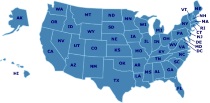
Looking for Another State?
Featured Resources
As an Amazon Associate, we earn from qualifying purchases. We get commissions for purchases made through links on this site.
A Child's Story of America
This text reads like a story book more than a history textbook. This book has a decidedly Christian bent. Students are given a comprehensive overview of U.S. history from Columbus to the present. Review questions are included throughout, as well as helpful maps. The text contains numerous pictures and large print. An optional test packet and answer key is available.

Secret of Childhood
Maria Montessori describes the child with warmth and the exactness of a scientist. She also discusses the array of materials and techniques needed to release his learning potential.

More Charlotte Mason Education: A Home Schooling How-To Manual
After providing an important work in explaining the Charlotte Mason method for homeschoolers, Catherine Levison goes deeper into the use of this method in the home with her subsequent work. This book expands the information from the first book and offers ideas to incorporate the rich and uplifting philosophy into your home education. There are specific tips for high school, schooling through challenges, and more.

Great Lodges of the National Parks: The Companion Book to the PBS Television Series
Stand amid soaring Douglas fir in the great hall of Glacier Park Lodge or sit in the setting sun and gaze into the Grand Canyon at El Tovar. This beautiful gift book will transport you to the majestic lodges of our national parks to relive the glory of past vacations or plan adventures anew. This book and the PBS television series of the same title (to air in spring 2002) take armchair travelers into these architectural wonders and explore the surrounding natural beauty of our national parks. Lo...

Montessori: A Modern Approach
Montessori: A Modern Approach has been called the single best book for anyone -- educator, childcare professional, and especially parent -- seeking answers to the questions: What is the Montessori method? Are its revolutionary ideas about early childhood education relevant to today's world? And most important, especially for today's dual-career couples. Is a Montessori education right for my child?Paula Polk Lillard writes both as a trained educators and as a concerned parent -- she has many yea...