Map & Globe Skills
The ability to properly read maps and globes gives you an opportunity to explore different places, people, and cultures in the real world. These resources, teaching tips, and ideas will help make it easy for your children to learn to read and understand maps and globes.
Activities & Experiments

Name That Country Game
"Dear Pen Pal, Konnichi wa! We've been to see Mt. Fuji. Name my country! Sayonara, Michiko." Challenge your group with this fast-paced geography game, created in 1992 by Educational Insights, Inc. Everyone begins at the post office. Players twirl a finely printed spinner (built into the game board itself) to select one of 60 countries. If the player can correctly identify the country's location on the board's numbered map, he or she may advance along the path to the finish. Bonus moves are won by landing on "postcard" spaces, listening to the clues on one of the 40 postcards, and correctly identifying the pen pal's country. (The sample postcard above came from Japan.) A more challenging game can be achieved by requiring players to name the country's capital; answers are provided. --Liane Thomas

Great States Board Game
What is the capital of NJ? Where is the Football Hall of Fame? These are just a few of the hundreds of questions players are asked as they adventure around the USA discovering state attractions and landmarks, capitals, state abbreviations, state locations and more. In order to answer the questions on the cards, players must look closely at the colorful USA map game board, becoming familiar with the geography of the country. Players must hurry to find the answers as the mechanical timer ticks. Contents: Game board, 100 Figure cards, 100 Fact cards, 100 Find cards, 1 spinner, 1 mechanical timer, and game rules. Duration of Play: 20 minutes. 2-6 players.
Postcard Kids
Geography Postcard Kids Project started for homeschooled children around the world in October of 2002. It is intended to help enhance geographic studies by sending postcards from their local area to other postcard kids around the world.
Teaching Tips & Ideas
Knowledge Quest
Knowledge Quest offers historical outline maps and timelines designed for the interactive study of world history and geography.
How I Teach a Large Family in a Relaxed, Classical Way: History
A look at teaching history across several grades using the classical method of education and a rotation of history every four years.
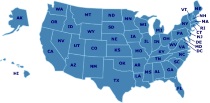
Looking for Another State?
Featured Resources
As an Amazon Associate, we earn from qualifying purchases. We get commissions for purchases made through links on this site.

Montessori: A Modern Approach
Montessori: A Modern Approach has been called the single best book for anyone -- educator, childcare professional, and especially parent -- seeking answers to the questions: What is the Montessori method? Are its revolutionary ideas about early childhood education relevant to today's world? And most important, especially for today's dual-career couples. Is a Montessori education right for my child?Paula Polk Lillard writes both as a trained educators and as a concerned parent -- she has many yea...

Handbook of Nature Study
A matchless handbook for decades, this classic work has been the natural history bible for countless teachers and others who seek information about their environment. Written originally for those elementary school teachers who knew little of common plants and animals, and even less about the earth beneath their feet and the skies overhead, this book is for the most part as valid and helpful today as it was when first written in 1911―and revised in the spirit of its authors by a group of naturali...

Secret of Childhood
Maria Montessori describes the child with warmth and the exactness of a scientist. She also discusses the array of materials and techniques needed to release his learning potential.

Kids' Poems (Grades 1)
Regie Routman shares her delightful selection of free verse poems written by first graders that will inspire your second graders to think, I can write poems like this too! Regie provides strategies for using kids' poems as models to guide children to write poems about things they know and care about: learning to skate, disliking asparagus, playing with a best friend, and more. She describes the way she invites children to study the model poem, beginning by asking kids, What do you notice? She sh...

More Charlotte Mason Education: A Home Schooling How-To Manual
After providing an important work in explaining the Charlotte Mason method for homeschoolers, Catherine Levison goes deeper into the use of this method in the home with her subsequent work. This book expands the information from the first book and offers ideas to incorporate the rich and uplifting philosophy into your home education. There are specific tips for high school, schooling through challenges, and more.